
What you get at the end.
The quiz asks five things: how you feel across the month, what you've tried, what you want most, what's held you back, and your age bracket.
Then it hands you The Blocker List: the everyday things that stop the iron you already eat from doing its job. Here's one from it, free.
Blocker one of several
Your coffee. Coffee, tea and matcha taken with a meal cut how much iron you take up from that meal. If your flat white lands with breakfast, it's working against the iron on the plate. The list tells you how far to move it.
the rest is two minutes away
Everyone's tired. And you're tired too. One doesn't cancel out the other.
Three numbers that make it a fair question to ask.
42.2%
of Australian women aged 30 to 49 don't get enough iron from food. Almost one in two at 18 to 29.
ABS, Usual nutrient intakes 20231
18 vs 8 mg
a day. What a woman aged 19 to 50 needs against a man. The difference is what goes out each month.
NHMRC, via healthdirect2
170 of 900
women on our waitlist signed up for one reason: "iron supplements upset my stomach". Another 324 take the tablets anyway.
bloodflo² waitlist quiz3
You're not imagining it, and you're not the only one. The quiz tells you where you sit.
Didn't get to the end of the video?
Most people tap through before the two minutes are up. Here it is, and under it the version you can read in 40 seconds.
Sound on. 2 min 2 sec.
The 40-second version
Iron sits inside your red blood cells, in haemoglobin, and carries oxygen to every part of you. Your brain needs it too.
Every month you lose some, and food alone often falls short.
The usual answer is a tablet. Chalky, metallic, and for a lot of women, rough on the stomach.
Not all iron is the same. bloodflo² Replenish uses ferrous bisglycinate, a chelated iron known for being gentle on the stomach and well absorbed, with acerola cherry for the vitamin C that helps your body take it in. Plus beetroot, pomegranate and vitamin D.
One berry stick sachet in water, every second day. Made in Australia. Vegetarian, vegan and gluten free.
Because iron contributes to the reduction of tiredness and fatigue.4
The research, if you want it.
Every decision in the sachet has a reason. Tap any of them.
Why a chelated iron and not a tablet salt
Most tablets use iron salts like ferrous sulfate. Ferrous bisglycinate is iron bound to an amino acid. In a double-blind crossover trial, 38 women took both at the same 50 mg dose, two weeks each. Significantly more preferred the chelated form, and the researchers put that down to fewer side effects: bloating, constipation and nausea were all lower on it.
In a University of California, Davis study, iron from ferrous bisglycinate added to a maize porridge was taken up about four times as well as iron from ferrous sulfate: 6.0% against 1.7%.
Coplin et al., Clinical Therapeutics 19915 · Bovell-Benjamin et al., American Journal of Clinical Nutrition 20006
Why every second day
At ETH Zurich, forty young women with low iron stores took the same iron either every day or every other day. On alternate days they absorbed a larger share of it: 21.8% against 16.3%. The researchers put it down to hepcidin, the hormone that decides how much iron the gut lets through. It rises after each dose and takes about a day to settle.
That trial used doses far larger than a food sachet, in women with low iron stores, so we don't claim its numbers for bloodflo². We built the routine around it.
Stoffel et al., The Lancet Haematology 20177
Why acerola cherry
Vitamin C "contributes to iron absorption from food", in the words the Food Standards Code allows. Acerola, a small red cherry from South America and the Caribbean, holds around 50 times the vitamin C of an orange by weight: published figures run from 1,000 to 4,500 mg per 100 g, against about 50 mg for a peeled orange. We sourced it ourselves and put it in the same sachet.
Iron and tiredness, in women who weren't anaemic
Two university trials looked at women with periods, not anaemic, nothing a doctor would flag, who were tired without an obvious reason. In the BMJ trial, 144 women aged 18 to 55 took iron or a placebo for four weeks: fatigue scores fell 29% on iron and 13% on placebo. In the larger CMAJ trial from the University of Lausanne and the University of Geneva, 198 women took iron or placebo for 12 weeks: fatigue fell 47.7% on iron against 28.8% on placebo.
Both used prescription-strength doses, under a doctor. bloodflo² is a food, not a treatment, and this page can't tell you what your iron is doing. It's why the Food Standards Code lets a food with enough iron say that iron "contributes to the reduction of tiredness and fatigue".
Verdon et al., BMJ 20039 · Vaucher et al., CMAJ 201210 · FSANZ Schedule 44
If you train
Exercise raises a hormone that makes the gut take in less iron for a few hours after a session, and hard training uses more of it. An Australian review by researchers at Edith Cowan University, the University of Western Australia and the WA Institute of Sport found "up to 35 percent of female athletes are iron deficient", against about 5 percent of the general population.
Sim et al., European Journal of Applied Physiology 201911
Iron and your brain
Researchers at the Florey Institute in Melbourne describe iron as vital for making the brain's chemical messengers, for the insulation around nerve cells and for the energy supply inside them. In the Code's words, iron "contributes to normal cognitive function".
Hare et al., Frontiers in Aging Neuroscience 201312 · FSANZ Schedule 44
What held other women back.
Straight from the quiz. Pick yours.
"I just never got around to it." (227 women)
Two minutes now, and we do the remembering. One email the day bloodflo² is released, and The Blocker List to read in the meantime.
"I wasn't sure it would work for me." (183 women)
bloodflo² is a food, not a medicine, and we won't promise how you'll feel. What we can show you is what's in it, where it's made, and the research behind every decision, which is all on this page. The quiz costs two minutes and nothing else. There's nothing to buy yet.
"Is this for someone my age?"
Vanessa built it for herself first. Then 900 women took the quiz, aged 18 to 50 plus, and the answers barely moved with age. About four in ten take iron tablets, in every bracket. About one in five signed up because supplements upset their stomach, in every bracket. Whatever box you tick, you won't be the only one in it.
A note from Vanessa, founder of bloodflo²
I couldn't get past 3pm. Then I couldn't find anything that wasn't a tablet.
I'm a mum. I run a business. I train. And for years, every day fell over at the same time.
My blood tests kept saying the same thing.
Iron at 6. Then an infusion. Then more bloods.Then the same packet of tablets everyone gets handed, and a stomach that wouldn't take them.
So I went looking for anything else. Coles. The chemist. Every big retailer. Whole aisles of protein, creatine and energy drinks, and the one nutrient I was short on came in one form: a tablet that hurt.
Everyone's obsessed with the top of the pyramid. My foundation was cracked, and nobody was selling anything to fix a foundation.
How is there nothing else?That question is where bloodflo² started. We looked for this on every shelf in Australia and it didn't exist. So we made it. Ferrous bisglycinate, acerola cherry, pomegranate, beetroot and vitamin D, in one stick you drink every second day. Made in Australia.
The pomegranate and beetroot are the two fruits people have always associated with blood flow. That's where the name comes from. bloodflo², with the little 2 for the oxygen your iron carries.
I made it for me first. Then for the woman who'd rather put back what she loses than push through without it.
Vanessa
Founder, bloodflo²
Start with the two-minute quiz.
Here's exactly what happens:
- 1Five questions. Two minutes. No blood test, nothing to buy.
- 2The Blocker List lands straight away.
- 3We tell you the day bloodflo² is released. The list hears first, in order.
900 women on it. One email when it's out. Unsubscribe any time.
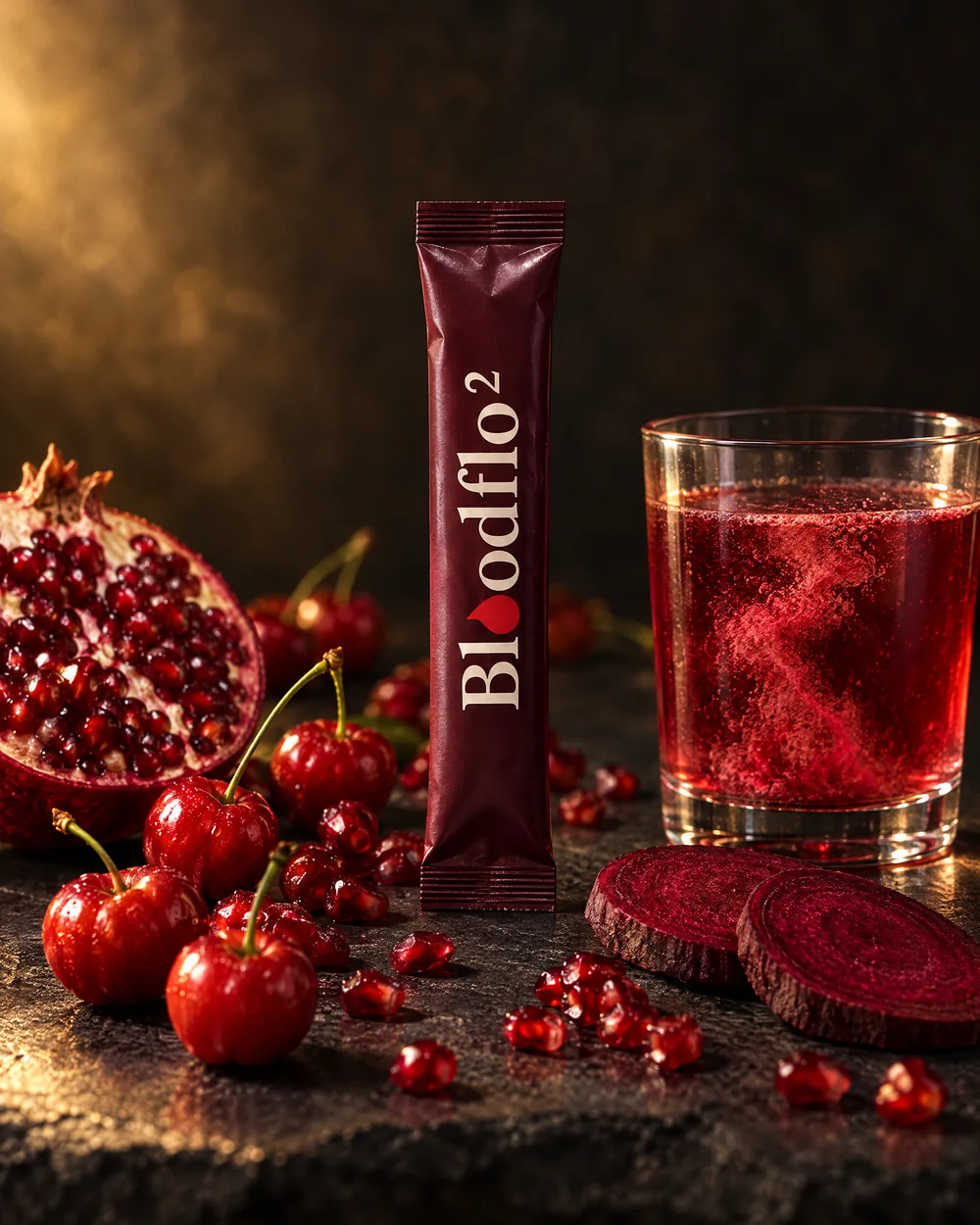
One berry stick sachet in a glass of water, every second day. 45 sachets is 90 days.
Inside: ferrous bisglycinate, acerola cherry, pomegranate, beetroot and vitamin D.
not out yet. the list hears first.
Sources
- Australian Bureau of Statistics. Usual nutrient intakes, 2023. Released 17 March 2026. abs.gov.au/statistics/health/food-and-nutrition/usual-nutrient-intakes/latest-release
- National Health and Medical Research Council, Nutrient Reference Values for Australia and New Zealand, as published by healthdirect: Foods high in iron. healthdirect.gov.au/foods-high-in-iron
- bloodflo² waitlist quiz, pulled 5 November 2026.
- Food Standards Australia New Zealand. Food Standards Code, Schedule 4: Nutrition, health and related claims. Pre-approved general level health claims for iron and vitamin C. legislation.gov.au/F2015L00474
- Coplin M, Schuette S, Leichtmann G, Lashner B. Tolerability of iron: a comparison of bis-glycino iron II and ferrous sulfate. Clinical Therapeutics 1991;13(5):606-612. pubmed.ncbi.nlm.nih.gov/1799918
- Bovell-Benjamin AC, Viteri FE, Allen LH. Iron absorption from ferrous bisglycinate and ferric trisglycinate in whole maize is regulated by iron status. American Journal of Clinical Nutrition 2000;71(6):1563-1569. doi.org/10.1093/ajcn/71.6.1563
- Stoffel NU, Cercamondi CI, Brittenham G, et al. Iron absorption from oral iron supplements given on consecutive versus alternate days and as single morning doses versus twice-daily split dosing in iron-depleted women: two open-label, randomised controlled trials. The Lancet Haematology 2017;4(11):e524-e533. doi.org/10.1016/S2352-3026(17)30182-5
- Acerola. Review of Natural Products, Wolters Kluwer Health, via Drugs.com. drugs.com/npc/acerola.html
- Verdon F, Burnand B, Fallab Stubi CL, et al. Iron supplementation for unexplained fatigue in non-anaemic women: double blind randomised placebo controlled trial. BMJ 2003;326:1124. doi.org/10.1136/bmj.326.7399.1124
- Vaucher P, Druais PL, Waldvogel S, Favrat B. Effect of iron supplementation on fatigue in nonanemic menstruating women with low ferritin: a randomized controlled trial. CMAJ 2012;184(11):1247-1254. doi.org/10.1503/cmaj.110950
- Sim M, Garvican-Lewis LA, Cox GR, et al. Iron considerations for the athlete: a narrative review. European Journal of Applied Physiology, 2019. research-repository.uwa.edu.au
- Hare DJ, Ayton S, Bush AI, Lei P. A delicate balance: iron metabolism and diseases of the brain. Frontiers in Aging Neuroscience 2013;5:34. doi.org/10.3389/fnagi.2013.00034